Sunday, May 12, 2013

BCC PARAMOUNT 10 RR: WRAP-UP. A CLASSIC EVENT

NM ERIC GODIN MARKS 8.5/10 POINTS 
TO TOP PARAMOUNT SCORING
NM Eric Godin scored 8.5 points to win Section 1 of Paramount.
Eric is one of BCC's most frequest and well-known participants of events for decades.
He is not only a chess master and teacher but also
the innkeeper of Apple of Boston Guest House, Back Bay, Boston MA
Ted Cross (left, playing Jonathan Lee in Round 10) secured 2nd place
in Paramount Section 1, with 6 points.
Nathan Smolensky, BCC President (right, playing NM Eric Godin
in Round 10) came in 3rd with 5.5 points.
 
Thomas Carr won Section 2 of the BCC Paramount event.
Thomas is a recent graduate of MIT and a precious resource
for the BCC on matters of computers and computer software and applications.
An intense, silent game of chess:
Thomas Carr (right) plays black vs William Wisdom
in Round 10 of the Paramount, Section 2.
Timothy O'Malley (left, playing black vs Tom Pendergast in
Round 10) captured 2nd place in Paramount, Section 2 with 6.5 points.
Tony Cortizas (right, playing Bernardo Iglesias, the
marvelous tournament director of this stellar event) came in
3rd with 6 points.

BCC PARAMOUNT: A MOST EXPANSIVE EVENT.
ALL GAMES PLAYED. ALL ADJOURNMENTS CONCLUDED.

Thursday, May 09, 2013

U1800 Boylston Chess Club Championship 

Mondays, June 3, 10, 17, 24


The Weaver Adams U1800 Championship begins the annual club championship cycle. It is followed by the Reubens-Landey U2200 Championship, the winner of which is seeded into the club championship - a round robin tournament of Boylston masters

 Weaver Adams U1800
WhenMon, June 3, 6:30pm – 11:00pm
Where:  Boylston Chess Club (map)
Description:
4SS. 40/90 G/20; 
Open to BCF members rated Under 1800; 
Entry fee: $20
Winner becomes the Boylston U1800 Champion and receives free entry into the Reubens/Landey U2199 - 1800 BCF Championship beginning on 7/1. 
Registration: 6:30 to 6:55; Rounds: 7:00
TD:  Bernardo Iglesias 


 __________________________________________________________


The Weaver Adams Qualifer is the first part of the Boylston Chess Club championship cycle.

You may play if you are rated under 1800 in the June 2013 supplement and a BCF member (you can join or renew at the start of the tournament.) The prize is the championship title, your name added to the coveted Weaver Adams trophy (created by Mike Griffin) 
and entry into the Reubens Landey.

Players rated between 1800 and 2200 in the June supplement may play in the Reubens Landey (U2200 championship) in July. The prize is the U2200 championship title and entry into the BCC Championship.

Players rated 2200 and above in the June supplement will be invited to play in the BCC Championship.

 ___________________________________________________________

Brian Perez-Daple is the BCF U1800 Champion for 2012 which he won with a a perfect 4.0 score in  tough and interesting games, including a hotly contested finale with the wily Harold Dondis.
___________________________________________________________

Past winners of the Weaver Adams are:

2012   Brian Perez-Daple
2011   Ken Ho, Mike Griffin, Khikmet Sadykov
2010   Alexander Paphitis
2009   Frank Frazier
2008   Jonathan Lee, Adam Yedidia
2007   Alexander Paphitis
2006   Alexander Paphitis, Jonathan Lee, Lior Rozhansky
2005   Robert Oresick, Joshua Blanchfield
2004   Mike Griffin
2003   Robert Oresick
2002   William MacLellan
2001   Mike Griffin
2000   Stephen E. Smith
1999   Bryan Clark
1998   Bryan Clark, Charles G. Alex
1997   Walter A. Driscoll III
1996   Hector Perez, Jared Becker
1995   Miguel A. Santana
1994   Andrew L. Yerre
1993   Charles G. Alex
___________________________________________________________ 


Weaver Warren Adams was born on April 28, 1901 in Dedham, Massachusetts. An American chess master, he participated in the U.S. Championship in 1936, 1940, 1944, 1946 and 1948. He won the Massachusetts State Championship in 1937, 1938, 1941 and 1945. In 1939, he wrote a book entitled "White to Play and Win." After publication he played in the U.S. Open at Dallas. He did not win a single game as White (3 losses and 1 draw) and won all his games (4 games) as Black! Weaver Adams won the 49th U.S. Open, held in Baltimore, in 1948. He also wrote "Simple Chess", "How to Play Chess", and "Absolute Chess." He passed away in Cedar Grove, New Jersey in 1963.
..............

Below is a photograph taken in Hastings on 28 December 1950. Lord Dunsany (standing on the right) is watching the first-round game between Alan Phillips and Weaver Adams.


 __________________________________________
about Weaver Adams:


WEAVER WARREN ADAMS (born Apr-28-1901, died Jan-06-1963) United States of America


.
Weaver Warren Adams was born on April 28, 1901 in Dedham Massachusetts. He was an American chess master. He participated in the U.S. Championship in 1936, 1940, 1944, 1946 and 1948. He won the Massachusetts State Championship in 1937, 1938, 1941 and 1945.

In 1939, he wrote a book entitled "White to Play and Win." After publication he played in the U.S. Open at Dallas. He did not win a single game as White (3 losses and 1 draw) and won all his games (4 games) as Black!

Weaver Adams won the 49th U.S. Open, held in Baltimore, in 1948. He also wrote "Simple Chess", "How to Play Chess", and "Absolute Chess."
.
In May, 1947, Weaver Adams, New England Champion, gave a 16-board simul in San Jose, winning all his games.

__________________________________________________


Weaver W. Adams An Autobiography 
Massachusetts State Chess Association, 1949, Robert W. Reddy (Ed.) p. 6-8

I was born on April 28th, 1901 to Frank H. Adams, native of Dedham, Mass., salesman for many years for Bellantine Breweries and later (after prohibition) for Ceresota Flour, and Ethel Weaver Adams, native of Newmarket, NH and graduate of Wellesley College. I am not directly related to the Presidents, John and John Quincy Adams, although the Adams's in and about Massachusetts are mostly of the same family, deriving from a Henry Adams who landed in Braintree in 1644. The family is quite famous and boasts of many statesmen, writers, historians, judges, preachers, etc. Footing the list comes a national chess champion. In the old days he would have surely been branded as a black sheep for wasting his time at so idle a pastime, and perhaps by many even today.

My schooling was conventional, Dedham Public schools and Dedham High School, but then they tried to make an engineer out of me by sending me to Massachusetts Institute of Technology. The result was not too good. During the first year a half dozen of us, after playing a few games at Walker Memorial in Cambridge, would regularly trek across the bridge to Ye Olde Boston Chess Club on Ashburton Place or to various dives in the West End, not the least attractive of which was the Lighted Lamp operated by Boston's famous Ambrose Gring.

Those were really the balmy days of chess in Boston. Well I remember listening to tales told many times over by John Barry, Will Miller, George Babbitt, and a host of others most of whom are no longer living. I seemed to have been a favorite with John Barry because I would talk chess and analyze with him until 4 A. M. in the morning after everybody else had either gone home or turned to a bridge game. At any rate I believe I learned most of my chess from Mr. Barry, and in 1922 attained to the club championship.

An autobiography is supposed to contain a statement as to when one learned chess, although it's not clear as to why this is so important. However, for the sake of the record, I began playing at the age of about twelve. An older brother of a friend next door taught the two of us to play, and would play us both simultaneously blindfold at Queen odds.

What I do think is important, however, is the time when he took us to Boston once to visit the Boston Chess Club which at that time was located in an alley off Boylston Street. I shall never forget the thrill it was to me to see for the first time the large club size pieces in action. Instinctively I seemed to feel that that was me. A friend of mine tells me that he had a similar experience on first visiting a stock exchange and seeing the ticker tapes in action. Curiously, all the rest of his life has .been spent in the stock market.

My chess activities , of course, did not have a good effect on my marks at M.I.T., and, due redness of my report card at the half year, I was politely asked to take a vacation. This I was quite agreeable too, since it afforded me additional time for chess playing. A year went by before my parents inveigled me into attending a military school in northern Vermont, and, six months later, re-entering my class at M.I.T. All knowledge is useful, and it is always futile to look back and say if we had done so and so, life would have been better. It is completely impossible to foresee the over all plan. We can live but a day at a time.

To continue my story, about 1924 Harold Morton had just won the championship of the Providence, R. I., chess club, and a purse was gotten up for a match to take place between Mr. Morton and myself for the championship of New England. Up to that time John Barry had been unofficially recognized as the strongest player in N. E., so, with his consent and approval it was logical that the winner of the match should hold that title. Thus, in 1924 I became the NE Champion and held the title until 1929 when Morton beat me in a succeeding match. Another match between us did not take place until about 1938 which Morton again won.

After his death in 1939 the title came under the control of the N. E. Chess Association and has been decided by an annual tournament (usually held over Labor Day weekend) ever since, which is all to the good, since I am strongly opposed to the awarding of titles through private matches. The tournament method is pre-eminently fair and much more attractive to both the players and the public.

Thereby closes the local chapter in my chess career. At this time – say 1936 - I think that both Morton and myself - I know I did - thought that we were pretty good chess players. We were in for a rude awakening. In that year (1936) was held the first tournament for the Chess Championship of the United States, due to the retirement of Frank J. Marshall.

I recall that after the first few rounds I kept figuring that I might still win the tournament, provided I won all of the remainder of my games. In fact, this went on for several rounds, before I finally gave up hope of first prize. After nine rounds I was relatively proud of my score, since I had three wins and six losses, while Morton had nine goose eggs in a row. However, we finished in a tie for last place, since in the remaining six rounds Morton got six draws, and it was my turn for goose eggs. I mention this experience in order to caution the reader that unless he happens to play regularly in the chess clubs of New York City, he shouldn't put too much store by his showing in the chess clubs of other cities. There is really a difference.

In a considerable sense I feel that my serious chess playing did not begin until after 1936. Hundreds of hours I spent on opening analysis, with the result that there began forming in my mind the idea that by means of precise play White could perhaps emerge from the opening with just enough edge to win. Thus developed a small volume published in 1959 by the David McKay Co. of Philadelphia entitled "White to Play and Win", by Weaver W. Adams. Forthwith, in a tournament at Dallas, Texas in 1940 I proceeded to lose all of my games playing white and win all of my games playing black!

However, I still stick to my theory, and even under the handicap of bucking my own analysis (most writers sedulously avoid playing a move which they have recommended as best, because of fear of having to play against a line which their opponent has prepared against it) and despite the hours which I am advised that many of my opponents spend in trying to discover mistakes in my published variations in "Simple Chess," I nevertheless lost but a single half point with the white pieces in the Open Tournament at Baltimore in 1948. And it wasn't because the boys didn't try. There were my moves open for all to see in "Simple Chess." They could select any one of a hundred different opening variations and I would play the exact moves as published. Is this not just a little significant that white can win? And, if so, why is my favorite opening the Vienna, so damned by faint praise, and so shunned by all the celebrities? You answer that one. I can’t.

I don't wish to take up space by tournament records. All in all, they could be a lot better, except perhaps locally, inasmuch as I have won every City of Boston, Massachusetts State, end New England tournament in which I have taken part since 1956 - some dozen or more altogether. I will merely say that having played in eighteen national tournaments, including U. S. National, U. S. Open, Ventnor City, and the Pan American in Los Angeles in 1945, I feel that this experience should mean something, and I hope eventually to demonstrate that it is possible to play chess with consistent scientific accuracy.

The following is an example of such a game. It is one of five which I have thus far played with similar accuracy for the Log Cabin Chess Team of West Orange, New Jersey, of which I have recently become a member. It was played at Elizabethtown, New York, vs. a Montreal Team, and was part of the coast to coast 1949 match between Canada and the U. S.

Adams,W - Guze [B72]
US v Canada, 1940

1.e4 c5 2.Nf3 d6 3.d4 cxd4 4.Nxd4 Nf6 5.Nc3 g6 6.h3 Bg7 7.Be3 Nc6 8.Qd2 a6 9.g4 Nxd4 10.Bxd4 0-0 11.0-0-0 b5 12.Bg2 Bb7 13.f4 Qc7 14.Rhe1 Rfd8 15.Qf2 Nd7 16.Bxg7 Kxg7 17.Nd5 Bxd5 18.exd5 Nb6 19.f5 Nc4 20.g5 gxf5 21.Qxf5 Qd7 22.Qf4 Rac8 23.Be4 Rc5 24.b4 Rc7 25.Bf5 Qe8 26.Qd4+ Kg8 27.Qh4 e5 28.Qxh7+ Kf8 29.Qh8+ Ke7 30.Qf6+ Kf8 31.Re4 1-0


Alex Cherniack has posted 8 games between Weaver Adams and Harry Lyman, where you can see Harry Lyman 's opinion of the forced win for white theory.


______________________________________________________________________

Please read this profile by 

Stephan Dann

 Chess Journalist, Historian, and Organizer.

Weaver Adams "started" writing "White to Play & Win" in 1935, and, an early edition of this "informal" publication was with Harlow Daly's papers, ledgers and scrapbooks that Harry Lyman & I obtained in 1975...
Adams continued "publishing" revisions to his "dogged" theories for some 25 years, the last editions of what he termed "Simple" and "Absolute" chess being "issued" about 1960, though the last year his health enabled him to "carry on" might have been 1959...
The greatest collection of Adams' material published was "edited" by Sam Sloan in 2007, but few know of the existence of this "limited" edition, published on demand book that would have had Harry Lyman "giggling" with delight, as it was about chess, and not about the tragic life of one of its players. 
I posted copies of some crosstables from 1905 to 1939 at the Mass. Open in Leominster yesterday, including games from the 1964 U.S. Open.  It was an effort to "complete" the weekday/weeknight chess events in Massachusetts before 1940, but most of this would have been lost were it no for the dogged efforts of Harlow Daly to document them for his own records, to "index" his games...and you can view this & more today & on Monday in Leominster...
My work with John Donaldson and Andy Ansel (who attended yesterday in Leominster, driving up from Long Island with his daughter), focus on games as the real history, not the politics and "entertainment" that sometimes accompanies chess gatherings.  
Collecting games played by Weaver Adams, Harry Lyman and other past chess legends (you will see the many names in Daly's ledgers and scrapbooks from Abe Moses Sussmann--New England Champion at the dawn of the 20th century--to Putzman, Cabot, Gring, Morton, Sturgis, Welch, etc.) right at the Boylston CC in the box of 2,000 game cards, history that you can hold right in your hand.
The time has come to scan these cards, and, use them as the basis of the history of the club, history of Boston and Massachusetts chess, and as basis to do new promotional efforts for the game without borders on the Internet.  
E-books on Weaver Adams, Harlow Daly and the 1964 U.S. Open (as well as the 1964 Fischer Tour--also by John Donaldson) are not only possible, but are the next logical step in preserving the legacy of past chess giants and encouraging future educational and historical endeavors at the Boylston Chess Club, and the work of the Boylston Chess Foundation.
Weaver Adams' family is still alive and well in Dedham, and is confident that the chess community will continue to preserve his memory in the hearts and minds of future generations. Like Pillsbury, we will never forget his contributions to the Royal Game.
E-books may not in themselves help finance efforts to finance clubs or run tournaments, but these may validate the efforts of .org chess foundations to raise funds to carry out their missions. 
It's time for sharing the "wealth" of the 1975 donation from Harlow Daly beyond "75 years of affection for chess" and just 150 games. Just the typos in the hastily prepared 1975 volume would fill a page or two...and we owe it to the memory of Harry Lyman to do a much better job the second time around.  
You have my continued support in preserving the Boylston Chess Club as one of America's premier chess shrines.

Chess Horizons Under New Management

Chess Horizons is an award-winning, decades-long MA chess publication. It has been beleaguered of late. Its largest problem has been staying on any sort of schedule. This was because the former editor was Bob Messenger, whom I like to call "The Hardest Working Man in New England Chess." Putting "Editor" into the mix just proved too much. Sometimes there are are just not enough hours.

And so, Chess Horizons was put under new management last month. No committees. No searches. Just one person (or hopefully as you'll see, a small group of persons) in our community taking the reigns and moving forward.  "Decisions are made by those who show up," as President Jed Bartlett once said.

Let me introduce you to the new Chess Horizons team.  We'll start at the top just to get the tension out of the way.

Editor - Doc Kinne. Yea, that's me. Why me? What experience do I have? Well, I've worked as a semiprofessional magazine writer before, largely in the writing and computer technology fields. About 20 years ago, for two years, I was editor and publisher for a small newsletter/magazine, doing both the editing and the layout. Yes, there has been a good bit of water under the bridge, but I've done something like this before. I'm also a member of the Chess Journalist of America, not that that means much right now.

Layout & Photography Editor - Max Sewell. Max has been integral in making Chess Horizons the award-winning publication it has been. In a visual medium like a magazine the layout is every bit as crucial as anything else. I'd be dumb not to retain him, and I look forward to working with him!

Publications Consultant - Bob Messenger. Wait? Wasn't the entire point to separate Chess Horizons and Bob?  Well, not quite. As Publications Consultant Bob will be there to answer procedural questions and be able to supply a bridge from the old to the new as the new team gets going. I'm going to try to keep him from doing a lot, honestly, but I expect his role will be more important than even I can imagine right now.

Copy & Games Editor - Nathan Smolensky. Nathan is one of those competent people who showed up with ideas and an interest. His rating is now high enough (I actually entertained fantasies that I could beat Nathan a year ago!) that I very much trust him on games editing.

So, that's the team as it now stands. There is room, I think, for one or two more Copy Editors, and I'll entertain applications. I'd be looking for someone who has a strong computer and internet presence, can work with either Microsoft Word or LibreOffice Writer, and is prepared to give me deliverables. I'd like to see an Advertising Manager for Chess Horizons in the future, but first we need to get back on a regular schedule and hold that so that advertisers will want to advertise with us.

Oh! I was wrong! That's not the whole team. I left out, frankly, the most important person  - hopefully you! You as writer! A magazine cannot exist without it getting input and this nicely ties in with my editorial philosophy - Chess Horizons, I hope, will be very much a grassroots publication. Your publication, in fact. The team above is just the assemblers. I need you and your news, views, and opinions.

Chess Horizons will be accepting and looking for completed articles submitted as ASCII text, Rich Text Format .rtf files, Microsoft Word .doc files, and LibreOffice Writer .odt files. Game scores will be solicited either in .txt or .pgn formats. Photographs can be submitted as .jpg, .pgn, or .gif formats.

I can see trying to organize a stable of writers, and will be contacting some of you with regard to this soon. Would you want to put Stringer for Chess Horizons on your resume? Maybe!

Finally, the schedule. Chess Horizons over the last several years has been so erratic in this department that I hope this will be its greatest change and improvement. The magazine will be going back to a quarterly schedule and will roughly be maintaining the same page count, based on submissions. I'm an astronomer in my real life, so in my mind a quarterly schedule means the Solstices and Equinoxes. Instead of a May-September (or whatever) issue, we'll be having Spring/Summer/Fall/Winter issues with release dates falling on our about the seasonal starting dates. Deadlines for submissions will be the first of the appropriate months: 1 March, 1 June, 1 September, 1 December.

So, that's our big news for now. Questions, comments, and submissions can come to "kinnerc @ gmail.com".  I look forward to hearing from each of you!

Smolensky: Vote for me for MACA President 2013

Note: The views expressed in the following post are the personal opinions of one of the writers of this blog, and do not constitute any official Boylston Chess Foundation endorsement of a candidate for this position.

The ballots for the 2013 Massachusetts Chess Association elections have been sent out, and, if you were a MACA member as of this February, you should be receiving one shortly, or already have. As some of you may know, I am running for MACA's highest office. Today, I'm going to explain why you should vote for me.

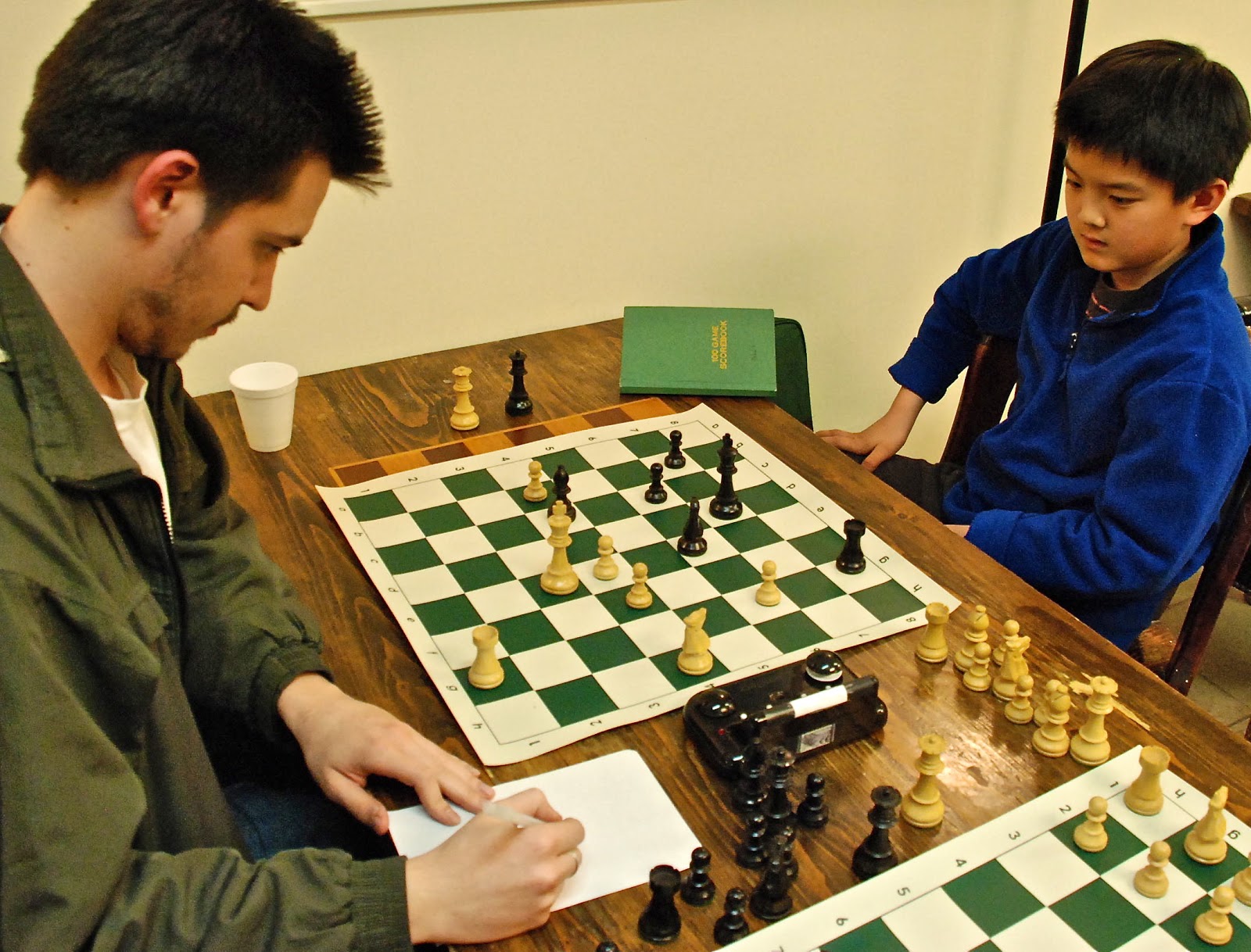
E. Godin - N. Smolensky. Photo credit: Steven Stepak


As you can see, I meet 1. e4 with e5. Why? Because I face the issues head on!

I'm not going to promise some wild flank approach, because that's just going to lead to complications, and complications are not what we need in MACA right now. Nor should we be sitting idly by and allowing our problems to expand into the heart of our Commonwealth. Plans to subvert the issues later on cannot be relied upon, either. Hypermodernism is fine on the chess board, but it isn't sensible with so much at stake.

With an e5 player at the helm, you can count on clear planning driven by good old common sense. New ideas will still be more than welcome in MACA's future - whether it's our scholastic offerings, our adult tournaments, the way we interact with club and school programs, or anything else we do, the possibilities are infinite, and I'm eager to hear the thoughts and suggestions of all those involved in chess in the state - but that future begins with having a functioning organization, with putting MACA in a position to succeed. 

So vote for me! I play e5!

Wednesday, May 08, 2013

BCC GRAND PRIX 4SS MAY::COMPETITIVE CHESS AT ITS BEST // THE STANDINGS TIGHTEN !!

BOYLSTON CHESS CLUB 
PRESTIGOUS GRAND PRIX EVENT FOR SPRING
MAY 11, 2013 4SS 60/SD (+5"delay)
 
Springtime fun at the Boylston Chess Club
This is a great tournament for the kids. Kids vs kids.
And adults vs kids.
Yes. The weather forecast for Saturday is: light springtime rain.
The perfect weather for an indoor chess tournament!
And the entry fee for this tournament terrific.
Please check Boylston Chess Club Home Page/
"Calendar of BCC Events" for all the facts.
Get your cash or check in by tomorrow (Thursday)
 and pay only $10 ($5 for members) 
[stop by the BCC tomorrow evening 7:00 - 10:00 PM during
Thursday Night Swiss event. Give to the TD.]
And: by 11:59 PM Friday by PayPal.
Stay tuned for the updated standings 
of the Grand Prix in all rating prize categories.
Grand Prix Standings through April, 2013:
U2400: Eric Godin 10; Andrew Wang 5. U2200: Jesse Nicholas 10; Carey Theil 4.5; 
Emanuel Mevs 4; Arthur Nugent 3;  Timothy Sage 2.5 Philip Nutzman 2; Tony Blum 1.5. 
U2000: Mike Griffin 8.5; Carissa Yip 6.5;  Michelle Chen 6.5; Mateos Sahakian 5.5; 
Nithin Kavi 4; Arthur Tang 4;  Jason Tang 4; Luke Lung 3; Loring Lauretti 3; Sandeep Vadlamudi 3; Nathan Smolensky 3; Jerry Williams 2.5; Walter Driscoll 2; Ross Eldridge 2; Joel Wald 2;
Conway Xu 2; Armen Martirosyan 2; Aidan Sowa 1.5; Oliver Traldi 1.5; 
Katherine Gasser 1;  Allen Wang 1;  U1800: Harold Dondis 5.5; Rohan Shankar 5; Tony Cortizas 4; Eric Matthews 3; Robert Holmgren 1.5. U1600: Chen Bai 8.5; Richard Mooney 6; 
Daniel Giaimo 5; Eric Feng 4.5; Eddie Wei 4.5; William Wisdom 4; Gabriel Birzu 4.5; 
David Martin 4; Eddie Wang 3;  Matthew Lee 2.5; Mark O'Brien 2; Kevin Anthony 2. 
U1400: Lucy Cai 6; Brandon Wu 6; Matthew Manzo 3; Sandeep Shankar 2; 
Christopher Burkhart 1.5; Ron Riley 1. 
U1200: Larry Jin 4; Richard Chen 2; David Sun 3; Edward Chiu 2.5; Richard Chen 2; 
Anthony Di Nosse 2; Michael Yu 2; Ji Tuo 1.
See you all this Saturday, bright and early!
The competition heats up! Be part of the action

Sunday, May 05, 2013

TOP SCHOLASTIC PLAYER IN MASSACHUSETTS CAPTURES 1ST PLACE IN BCC MASTER QUAD

NM MIKA ANDREW BRATTAIN SCORED 2.5 POINTS OUT OF 3 FOR CLEAR 1ST IN THE BCC MASTER QUAD. NM CAREY THEIL WAS CLEAR 2ND WITH 2 POINTS.
NM MIKA BRATTAIN, CLEAR 1ST IN BCC MASTER QUAD.
NM Mika Brattain vs NM Carey Theil: draw!
Joshua Quint, black v Nithin Kavi, R3. Jesse Nicholas observes.
Jesse won QUAD 2 with 2.5 points. Quint was 2nd with 2 points.
Opening set-up: Jesse Nicholas (right) vs Josh Quint, Round 3.
Hector Perez (right) plays Mike Griffin, Round 2. Perez won QUAD 3
with 2.5 points.
Jason Tang plays black vs Alex Fauman. 
Alex scored 2 points to capture clear 2nd in QUAD 3.
Garrett Kingman plays black vs Robert Title in Round 2
Kingman scored a perfect 3.0 to capture clear first in QUAD 4.
(background): Lucy Cai vs Jerry Williams; Sammi Pan, black vs Michael Yu; 
William Wisdom vs Allen Yuen.
Jiaying Lucy Cai vs Jerry Williams, Round 2.
(background): Wisdom vs Yuen.
Postmortem: Cai vs Williams: (left to write) Jerry Williams, Bernardo Iglesias, TD, 
NM Eric Godin, Michael Yu, Garrett Kingman, Lucy Cai and Jason Tang.
William Wisdom vs Allen Yuen. 
Allen scored a perfect 3.0 in the Mini-Swiss Event to secure 1st place.
Michael Yu and Anthony Di Nosse went 2-3rd with 2 points.
Allen Yuen (right) faces off with Michael Yu in Round 3,
to determine the winner of the Mini-Swiss.
Faces in the field: Lucy, Sammi, Will . . . 
Middlegame: Perez (right) vs Jason Tang
Complex middlegame: Natasha Christiansen (right) vs Nithin Kavi, Round 3.
Natasha is the wife of GM Larry Christiansen of 
2nd Tuesday of the Month Simuls at South Station.
Larry is playing in the US Chess Championship, in St. Louis, MO. Indeed at the time
of the publishing of this post, Larry is playing GM Gata Kamsky. Both are 2 for 2 at this time.
The Greater Boston Area Chess Community shouts out a hearty cheer for Larry's success!
Also: congratulations to Garrett Kingman and Allen Yuen who will be graduating from Harvard University at the end of May! We always enjoy the participation of Harvard students and welcome all the Crimson Family:  faculty, staff and student body to play in BCC events year-round!
Final note: to me, this looks like a win for White: Black to move.
What's your opinion?
There were 21 participants in this event.
See you next Thursday for Round 2 of the Thursday Night Swiss. 
This month has 5 Thursdays, so five rounds. Not too late to join
this BCC premier event with a half-point bye for Round 1. 
Also, this coming Saturday, May 11: BCC Grand Prix!
Mark your chess calendar!
Follow the US Chess Championship, St Louis, MO 2013:

Wednesday, May 01, 2013

BCC QUADS: ALL PLAY ALL // PRIZES // FUN // EARLY FINISH !! // FRIENDLY AMBIANCE // GOOD CHESS

This Saturday: May 4th "Happy Springtime"
What more could you ask for?  This event features groupings of 4 players by rating.  And you have the chance to win a nice cash prize for your efforts.  3 Rounds:  5:00 PM finish time.
Fun for the whole family. 
This event is perfect for children of all ages
and playing strengths.
Come to the Boylston Chess Club. 
Bring your brothers, your sisters, your schoolmates and friends.
60/SD (plus 5 second delay)
Check out the facts at the BCC Home Page:
"Calendar of BCC Events"
See you this Saturday!
Weather forecast: Sunny and mild!
Yummy!

Sunday, April 28, 2013

GMs Storm Boylston!

The Boylston Chess Foundation Lecture Series continued this past Saturday with an exciting visit from GM Leonid Kritz, who offered a Tactical Thunderstorm, exploring some wild positions with the attendees.

The Boylston was also thrilled to welcome GM Kritz's wife, GM Nadezhda Kosintseva, and their good friend, and longtime friend of the Boylston, GM Eugene Perelshteyn.

All photos courtesy of Steven Stepak.


BCC EARTH DAY $5 OPEN: SAVE A TREE, SAVE A SOUL

The first Earth Day happened on April 22, 1970. Established by Gaylord Nelson, U.S. Senator from Wisconsin, to focus attention on and duty to preserving a healthy, sustainable environment. In the spirit of this concept, the BCC held a 32 player 4 round Swiss, in 2 sections: Premier and U1650. In a highly competitive field of 19 players, NM Carey Theil and Expert Jesse Nicholas tied for 1st place in the Premier Section with a score of 3.5 out of 4.
NM Carey Theil 3.5 points 1-2nd place in Premier Section.
Carey brought his rating over 2200 in this event, to 2204. Bravo Carey.
Keep up the good work.
Jesse Nicholas, 1-2nd with 3.5 points in Premier Section.
Jesse is fast heading towards the 2200 rating mark with 2156. Bravo Jesse.
A tense, calculating struggle in Round 3: Nicholas v Theil: draw!
NM Eric Godin 3-9th, Premier Section with 2.5 points.
Terrence Fricker, 3-9th, Premier Section.
Carissa Yip, 3-9th in Premier Section
Oliver Traldi 3-9th, Premier Section
Carissa Yip vs Seth Lieberman, Round 2: draw.
Lieberman also scored 2.5 points to place 3-9th in Premier Section.
Traldi vs Jerry Williams; Fricker vs Arthur Tang (also 3-9th in Premier Section)
and (back back): Kavi, black vs Dondis. Round 2.
Top Scholastic Players in Massachusetts Nithin Kavi vs Carissa Yip: draw!
Round 4 action. (background) Sandeep Vadlamudi vs Arthur Tang; 
Terrence Fricker, black vs Jerry Williams.
Nithin Kavi, 3-9th, Premier Section; runner up, "best hat."
Harold Dondis, Esq. at 90+ scored +1 rating points in the Premier Section.
Harold won "best hat" of the event. 
Long hard think: Gabriel Birzu plans his strategy vs a
well-prepared Brandon Wu.  Birzu scored 3.5 points to win clear 1st 
in the U1650 Section. Brandon was 2-6th.
Gabriel Birzu plays Michael Yu who came in 2-6th.
Tony Cortizas, 2-6th, U1650 Section
Sammi Pan writes her move playing Tony DiNosse in Round 2.
Sammi also scored 2.5 points to share 2-6th place.
(background) Ted Cross vs Nathan Smolensky, in a make-up 
Paramount Tournament game.
William Wisdom vs David Sun in Round 3. Sun also scored 2.5 points
to place 2-6th in the U1650 Section. 
PS: Is there a win for White in this position?
And Lieberman vs Traldi, Round 4: White is up a pawn. 
Enough to win? Game ended in a draw.  
There were 19 players in the Premier Section;  13 in the U1650,
for a total of 32 participants in Earth Day chess.