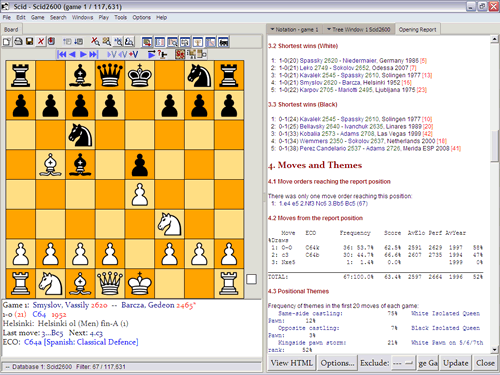
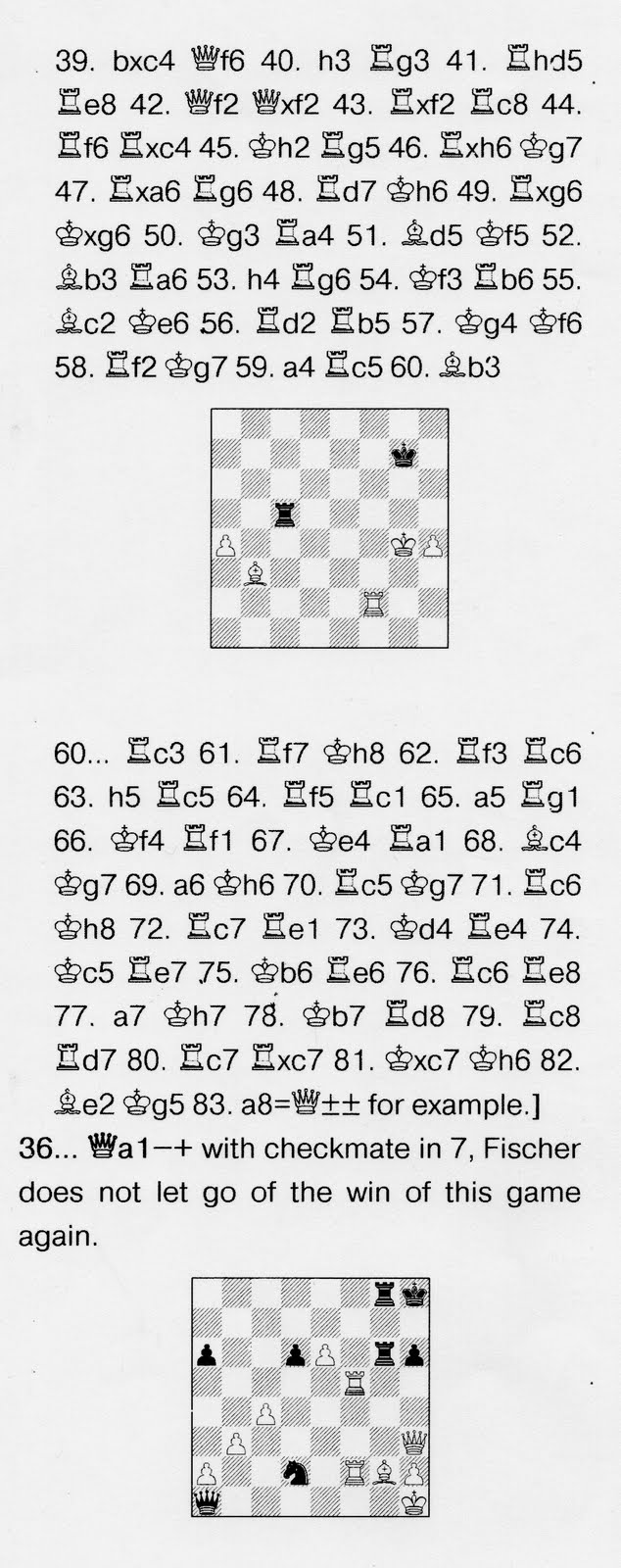
Steve Stepak discusses the game Doda versus Fischer at the Capablanca Memorial, Havana 1965. Did Doda miss a win?
[Please click on each image below for a more legible copy. Ed.]




The Chess Blog of the Boylston Chess Club... The Boylston Chess Club (BCC) is a part of the Boylston Chess Foundation (BCF).


 24.Qh8+ Kf7 25.Rh7+ Kg6 26.Rh6+ Kf5. All the good checks are gone and White's Queen is now under fire in the corner of the board: 27.Rxf6+ Rxf6 28.Qh3+ (or 28.Qh5 Rff8 29.g4+ Ke6 30.Qh6+ Kd7 31.Qxb6 Rfd8 32.e6+ Ke8 33.Qc6+ Kf8 34.Qf3+ Kg7 35.Re5 Rf8 36.Qc3 Kg8) Kg6 29.Qd3+ Kf7 30.Qh7+ Ke8 31.Qh5+ Kd7 32.Rd1+ Kc6 33.exf6 Qf6 – Black emerges unscathed with an extra piece.
Instead of 23.Re1, adding a centralized Rook to the attack on general principles, 23.Qh7+ Kf7 24.exf6! Qxf6 25.Rf3 would have won quickly. I was so fixated on using all my pieces (Qh5, Rh3, Re3, pawn on e6) that it never occurred to me two pieces on the edge of the board were enough in this position to put the game away.
And my opponent was right to play 23...Qe6. After 23...g5 24.Qh8+ Kf7, both of us overlooked 25.Qh7+! Ke8 26.Qg6+ Kd8 27.Rh7 Qe8 28.Rd1+ Kc8 29.Qg7, which cooks the King on the seventh rank.


|
| Aug 17, 2011 18:02 Moscow Time |

Mikhail Botvinnik. Photo: RIA Novosti |
|
Today the world chess community is celebrating today the 100th birth anniversary of Mikhail Botvinnik, who is regarded as one of the most prominent chess players in the world. No. 6 in the world history of chess and the first chess champion of the now-defunct Soviet Union, he was also a seven-time champion of the USSR in the period between the 30s and the 50s. Mikhail Botvinnik was a real patriarch of Soviet chess, who remained unparalleled for a very long time, a well-known Grand chess master and a chess theoretician, Yevgeny Vasyukov, says:
"All chess players admired him and did their utmost to adopt his experience in the field of chess. Each of us, representatives of the older generation, carried part of Botvinnik in our hearts. Mikhail Botvinnik is a very significant figure in the world of chess. He added much to the art of chess, including his training methods, practical work, regime of chess training, and of course, aspirations in chess. It is very difficult to find words to express what he did for the art of chess. All chess players, to a certain extent, are his disciples."
Mikhail Botvinnik won his first chess “fight” at the age of 14. Almost without any difficulty he defeated the then champion of the world Jose Raul Capablanca from Cuba in a simultaneous display.
By the way, it is exactly that match that brought him fame and strengthened the priority of the Soviet chess school. Two years later he became the youngest chess master in the former Soviet Union and made a successful debut at the USSR Chess Championship.
Jose Raul Capablanca, Emanuel Lasker, Wilhelm Steinitz, Mahgilis Eive, David Bronshtein, and Mikhail Tal - the prominent chess players of the world – were Botvinnik’s rivals at different times. And he defeated all of them. It is very hard to say which was the best of Botvinnik’s chess games. Actually, all his games are part of the chess history.
Botvinnik always invented something new. And he played more than 1000 games. All of them are known for their deep strategic plans, unexpected tactical strikes and initiative moving. Besides, Botvinnik was the first to pay paramount attention to chess theory, to work out an original plan of chess training and to create his own training methods which can be of help in achieving tangible results during competitions. Today many books of Mikhail Botvinnik on chess theory, and also on energetics and cybernetics, have been published not only in Russian but also in English, Hungarian, Danish, German, French, Swedish, and some other languages.


Charles Draftsby David Glickman
[republishing of a previous post]
This Saturday the ... Annual Charles Drafts Open is being held at the Boylston Chess Club. Charles died several years ago and so for newer members of the club and the broader readership of the weblog I thought it might be worthwhile to briefly review his story.
Charles was a disabled, double-amputee living in the housing projects in Mission Hill. He loved to play chess but his condition made it difficult for him to come to a club or attend tournaments. At some point in time he contacted the BCC to see if any players would be willing to come to his apartment to play. Over the years several heeded the call, but in particular club member Walter Driscoll was a frequent visitor. I believe Walter was also the driving force behind the Charles Drafts Open. At the beginning and for many years, the tournament was held at Charles' building in Mission Hill so that at least one time a year Charles would have an opportunity to play in a "traditional" chess tournament. Since his death, the tournament has continued at the club as a memorial event.
The introduction of internet chess was obviously a boon to Charles and he was an active player on the ICC. It was, in fact, in the middle of a chess game on the ICC in 1996 when the event occurred which thrust Charles into momentary international prominence:BOSTON -- A disabled man who became ill while logged on to an Internet chess site reached out to fellow players from around the world for emergency assistance.
Charles Drafts, a double amputee who types using a stick in his mouth, was playing chess in cyberspace Saturday on the multi-use World Wide Web site where 159 others also were logged on.
Suddenly, he sent out this message: "i'm having physical illness problems and need help."
"He was starting to have some really bad feelings, shortness of breath and dizziness, and he typed in a message to all our members," said Daniel Sleator, a computer science professor at Carnegie Mellon University near Pittsburgh who founded the Internet Chess Club.
"It took a little while to know whether it was serious or not because there's an awful lot of kidding and bantering that goes on," Mr. Sleator said. "At first, I think some people were thinking it was a joke. But others realized it was a serious thing and started getting the information right away."
Mr. Drafts managed to type in his address.... while several users tried to find out what symptoms Drafts was suffering, Andy McFarland of Owensboro, Kentucky, was calling Boston's emergency medical services on his second phone line. "When he finally got through, he told dispatchers where he was calling from and explained the situation," Howland relates. 'I think I lost them for just a second,' McFarland said. 'It's not something they get every day.'"
...firefighters rushed to Draft's home, but no one answered the door. They called McFarland back to verify the address. McFarland told the wire service, "The last thing I heard them say was, `We're going in,' and they hung up." ...a short while later Boston firefighters broke down his door to get inside. They rushed the 48-year-old man to Beth Israel Hospital, where he was listed in stable condition ..., suffering from an undisclosed ailment.
About 20 minutes later, a Boston dispatcher called to tell McFarland that they had found Drafts inside and that he had needed help.
[This text is a re-gifting of David Glickman's 2005 post.]