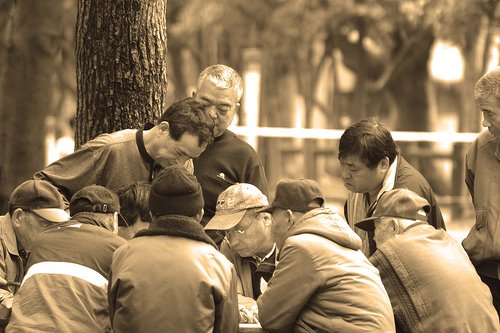
 A modified version of the scrum is
used in the new sport of ChessRugby
Post your caption in the comments.
Source

The Chess Blog of the Boylston Chess Club... The Boylston Chess Club (BCC) is a part of the Boylston Chess Foundation (BCF).
A modified version of the scrum is
The appointment will be for a period of four years (one year plus a further three years after a positive evaluation) and should lead to a dissertation. The gross monthly salary will be in accordance with the University regulations for academic personnel. It will range from 1,933 Euros (first year) up to a maximum of 2,472 Euros (fourth year) gross per month. The envisaged starting date is 1 September 2006.Get your application in soon.
Another up side, of course, is the trash talking. In regular face-to-face chess games, unless you're playing speed chess or a pick-up game in Washington Square Park, trash talking is discouraged. The tradition in chess has always been the non-verbal psych out.
But it was never considered rude to trash talk in postal chess.
Larry Christiansen is a Southern California native who now resides in Cambridge, Massachusetts with his wife, Natasha. One of the greatest attacking players in the history of the United States, Larry was a star of the Bundesliga (a German league of chess teams) and was U.S. Champion in 1980, 1983, and 2002...Of course, we always like to point out that both Larry and Natasha are members of the Boylston Chess Foundation.
Weaver W. Adams -- An Autobiography
Massachusetts State Chess Association, 1949,
Robert W. Reddy (Ed.) p. 6-8
I was born on April 28th, 1901 to Frank H. Adams, native of Dedham, Mass., salesman for many years for Bellantine Breweries and later (after prohibition) for Ceresota Flour, and Ethel Weaver Adams, native of Newmarket, NH and graduate of Wellesley College. I am not directly related to the Presidents, John and John Quincy Adams, although the Adams's in and about Massachusetts are mostly of the same family, deriving from a Henry Adams who landed in Braintree in 1644. The family is quite famous and boasts of many statesmen, writers, historians, judges, preachers, etc. Footing the list comes a national chess champion. In the old days he would have surely been branded as a black sheep for wasting his time at so idle a pastime, and perhaps by many even today.
My schooling was conventional, Dedham Public schools and Dedham High School, but then they tried to make an engineer out of me by sending me to Massachusetts Institute of Technology. The result was not too good. During the first year a half dozen of us, after playing a few games at Walker Memorial in Cambridge, would regularly trek across the bridge to Ye Olde Boston Chess Club on Ashburton Place or to various dives in the West End, not the least attractive of which was the Lighted Lamp operated by Boston's famous Ambrose Gring. Those were really the balmy days of chess in Boston. Well I remember listening to tales told many times over by John Barry, Will Miller, George Babbitt, and a host of others most of whom are no longer living. I seemed to have been a favorite with John Barry because I would talk chess and analyze with him until 4 A. M. in the morning after everybody else had either gone home or turned to a bridge game. At any rate I believe I learned most of my chess from Mr. Barry, and in 1922 attained to the club championship.
An autobiography is supposed to contain a statement as to when one learned chess, although it's not clear as to why this is so important. However, for the sake of the record, I began playing at the age of about twelve. An older brother of a friend next door taught the two of us to play, and would play us both simultaneously blindfold at Queen odds. What I do think is important, however, is the time when he took us to Boston once to visit the Boston Chess Club which at that time was located in an alley off Boylston Street. I shall never forget the thrill it was to me to see for the first time the large club size pieces in action. Instinctively I seemed to feel that that was me. A friend of mine tells me that he had a similar experience on first visiting a stock exchange and seeing the ticker tapes in action. Curiously, all the rest of his life has been spent in the stock market.
My chess activities , of course, did not have a good effect on my marks at M.I.T., and, due redness of my report card at the half year, I was politely asked to take a vacation. This I was quite agreeable too, since it afforded me additional time for chess playing. A year went by before my parents inveigled me into attending a military school in northern Vermont, and, six months later, re-entering my class at M.I.T. All knowledge is useful, and it is always futile to look back and say if we had done so and so, life would have been better. It is completely impossible to foresee the over all plan. We can live but a day at a time.
To continue my story, about 1924 Harold Morton had just won the championship of the Providence, R. I., chess club, and a purse was gotten up for a match to take place between Mr. Morton and myself for the championship of New England. Up to that time John Barry had been unofficially recognized as the strongest player in N. E., so, with his consent and approval it was logical that the winner of the match should hold that title. Thus, in 1924 I became the NE Champion and held the title until 1929 when Morton beat me in a succeeding match. Another match between us did not take place until about 1938 which Morton again won. After his death in 1939 the title came under the control of the N. E. Chess Association and has been decided by an annual tournament (usually held over Labor Day weekend) ever since, which is all to the good, since I am strongly opposed to the awarding of titles through private matches. The tournament method is pre-eminently fair and much more attractive to both the players and the public.
Thereby closes the local chapter in my chess career. At this time – say 1936 - I think that both Morton and myself - I know I did - thought that we were pretty good chess players. We were in for a rude awakening. In that year (1936) was held the first tournament for the Chess Championship of the United States, due to the retirement of Frank J. Marshall. I recall that after the first few rounds I kept figuring that I might still win the tournament, provided I won all of the remainder of my games. In fact, this went on for several rounds, before I finally gave up hope of first prize. After nine rounds I was relatively proud of my score, since I had three wins and six losses, while Morton had nine goose eggs in a row. However, we finished in a tie for last place, since in the remaining six rounds Morton got six draws, and it was my turn for goose eggs. I mention this experience in order to caution the reader that unless he happens to play regularly in the chess clubs of New York City, he shouldn't put too much store by his showing in the chess clubs of other cities. There is really a difference.
In a considerable sense I feel that my serious chess playing did not begin until after 1936. Hundreds of hours I spent on opening analysis, with the result that there began forming in my mind the idea that by means of precise play White could perhaps emerge from the opening with just enough edge to win. Thus developed a small volume published in 1959 by the David McKay Co. of Philadelphia entitled "White to Play and Win", by Weaver W. Adams. Forthwith, in a tournament at Dallas, Texas in 1940 I proceeded to lose all of my games playing white and win all of my games playing black! However, I still stick to my theory, and even under the handicap of bucking my own analysis (most writers sedulously avoid playing a move which they have recommended as best, because of fear of having to play against a line which their opponent has prepared against it) and despite the hours which I am advised that many of my opponents spend in trying to discover mistakes in my published variations in "Simple Chess," I nevertheless lost but a single half point with the white pieces in the Open Tournament at Baltimore in 1948. And it wasn't because the boys didn't try. There were my moves open for all to see in "Simple Chess." They could select any one of a hundred different opening variations and I would play the exact moves as published. Is this not just a little significant that white can win? And, if so, why is my favorite opening the Vienna, so damned by faint praise, and so shunned by all the celebrities? You answer that one. I can't.
I don't wish to take up space by tournament records. All in all, they could be a lot better, except perhaps locally, inasmuch as I have won every City of Boston, Massachusetts State, and New England tournament in which I have taken part since 1936 - some dozen or more altogether. I will merely say that having played in eighteen national tournaments, including U. S. National, U. S. Open, Ventnor City, and the Pan American in Los Angeles in 1945, I feel that this experience should mean something, and I hope eventually to demonstrate that it is possible to play chess with consistent scientific accuracy.
The following is an example of such a game. It is one of five which I have thus far played with similar accuracy for the Log Cabin Chess Team of West Orange, New Jersey, of which I have recently become a member. It was played at Elizabethtown, New York, vs. a Montreal Team, and was part of the coast to coast 1949 match between Canada and the U. S.
Adams,W - Guze [B72]
US v Canada, 1940
1.e4 c5 2.Nf3 d6 3.d4 cxd4 4.Nxd4 Nf6 5.Nc3 g6 6.h3 Bg7 7.Be3 Nc6 8.Qd2 a6 9.g4 Nxd4 10.Bxd4 0-0 11.0-0-0 b5 12.Bg2 Bb7 13.f4 Qc7 14.Rhe1 Rfd8 15.Qf2 Nd7 16.Bxg7 Kxg7 17.Nd5 Bxd5 18.exd5 Nb6 19.f5 Nc4 20.g5 gxf5 21.Qxf5 Qd7 22.Qf4 Rac8 23.Be4 Rc5 24.b4 Rc7 25.Bf5 Qe8 26.Qd4+ Kg8 27.Qh4 e5 28.Qxh7+ Kf8 29.Qh8+ Ke7 30.Qf6+ Kf8 31.Re4 1-0

A few months ago, we had an item on Alexandra Kosteniuk, a Russian woman described as the Anna Kournikova of chess.
Now we see a story on Arianne Caoili, 19, an Australian player who the Aussie media say is the Anna Kournikova of chess. How many Annas are there in chess? What goes on in those chess clubs?

A serial killer detained in Moscow has confessed to killing 61 people of the 64 he was planning to kill — one murder for each of the chessboard checks.
Alexander Pichushkin, 32, a shop assistant, has claimed to be the notorious Bitsa Park serial killer, who Moscow police have been tracking down for more than half a year, Kommersant daily reports.
Pichushkin, who has already been nicknamed “Crazy Chess Player”, said he had initially planned to commit 64 murders, one for each of the chessboard checks. He also said there were three checks vacant, thus admitting to have killed 61.
"If it's not broken, don't fix it," said Elaine Gentile, a leading opponent who dismissed the new proposal.... "This is like a sacred historical spot," she said.
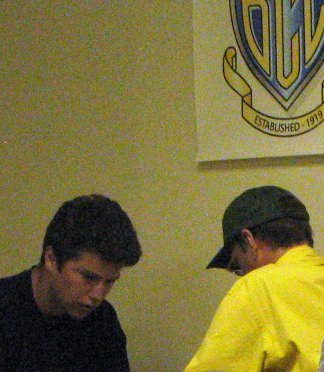 It came down to the final round - Jason Spector (2109) vs Scott Didham (1955) in Saturday's Legends: H. Bird tournament at the Boylston club.
Jillian's, a bar in downtown Albany, N.Y., known for its big-screen TVs tuned to sports channels, dance club, pool hall and video arcade, is about to experiment with a little cross-marketing: it will host a chess tournament this summer....Read "Albany bar to host chess tournament" from The Business Review.
Players will match up against five opponents in a series of 10-minute games. A no-talking rule has been waived and good-natured "trash talking" will be allowed.
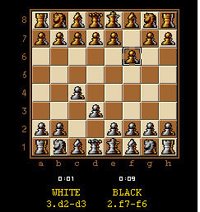 I have a couple of questions -
